
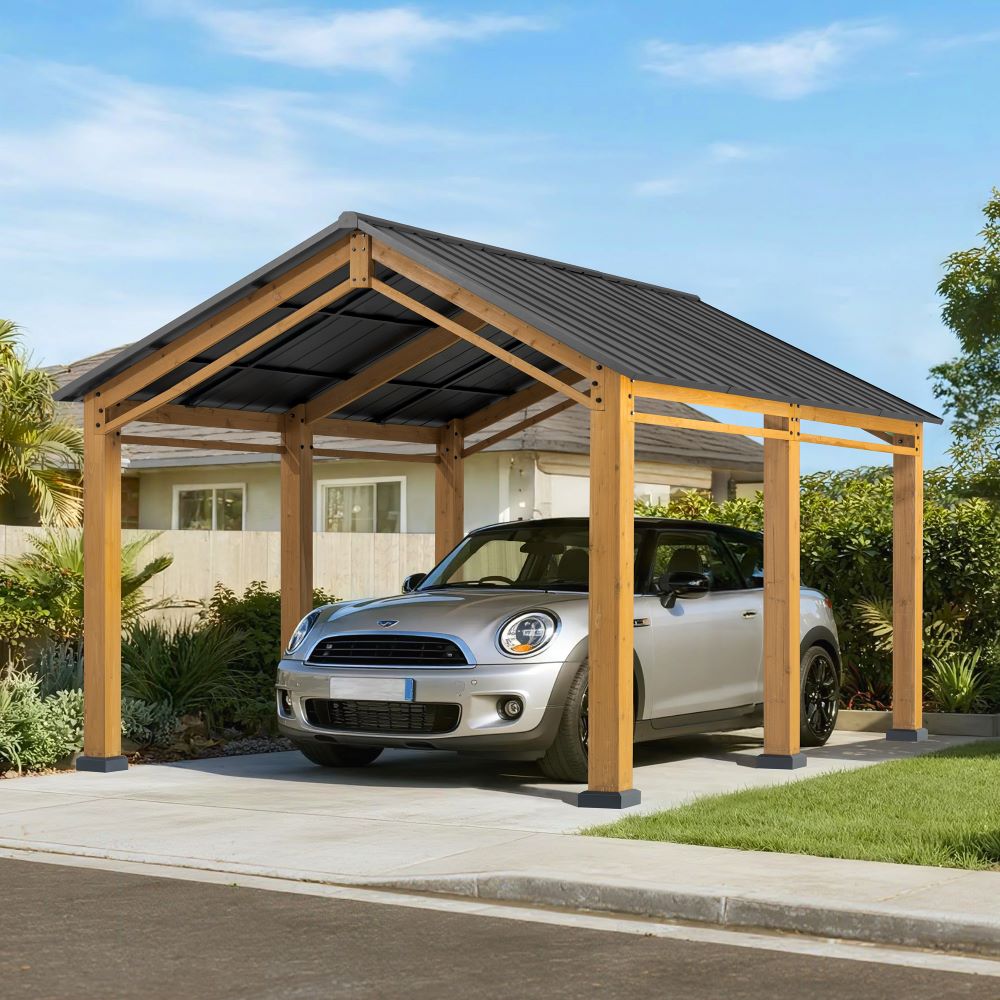
Does Sunjoy Carports suit your outdoor space? Consider temporary shade versus a fixed parking routine for RV or trailer storage
For an RV owner, SUNJOY carports are best assessed against the space and routine you already have, not against a generic idea of covered parking. Start by measuring the available length and width, then note how often the RV or trailer enters, leaves, and remains in place. A shelter that works for occasional shade may not suit a parking area used every day.

Start with the parking routine
Write down what the covered space needs to do. Is it mainly a place to leave an RV between trips, or do you need room to move around the vehicle while loading, cleaning, or accessing storage? The answer changes the importance of clear approach space, door access, and the position of nearby fences, trees, walls, and vehicles.
Measure more than the vehicle body. Record the overall length, width, and height of the RV or trailer, including equipment that stays attached or mounted. Then look at the route into the space. A suitable footprint on paper may still be awkward if the turning path is narrow or if the entrance requires repeated repositioning.
Also separate a temporary shade need from a fixed parking routine. Temporary shade suggests that flexibility, seasonal use, or a changing outdoor layout matters. A fixed routine places more emphasis on how the shelter fits the same parking movement each time. These are planning categories, not claims about how any particular model must be installed or used.
Match the space to the product description
The collection page discusses carports for vehicles, RVs, and equipment. It also describes possible uses including an outdoor workspace, shaded patio, or storage area. That broad range can help you frame the decision, but it does not establish that every model has the same dimensions, layout, or suitability for every RV or trailer.
For a shopper comparing carports for sale, the useful question is not simply whether a listing mentions RV use. Read the selected product page as a set of model-specific details. Compare the stated footprint with your measurements, consider the access route, and note whether the intended use is parking, storage, or a mixed outdoor area. Treat any feature that is not stated for the selected model as unresolved rather than assuming it is included.
Material descriptions provide another point of comparison. The page describes steel frames and weather-resistant roofing as features of metal carports. Those are page-listed descriptions. They should not automatically be expanded into guarantees about performance at your site, compatibility with a particular vehicle, or suitability for local conditions.
A practical comparison can therefore use three separate questions:
- Space: Does the stated product footprint leave the access and working room your routine requires?
- Use: Will the area serve mostly as a parking shelter, occasional shade, storage, or another purpose described on the collection page?
- Evidence: Is the detail stated for the selected model, or is it only a general description of the collection?
Separate kit contents from installation assumptions
The SUNJOY carport collection describes its kits as including pre-cut parts, hardware, and step-by-step instructions. That is useful information when you are reviewing what the kit description says it contains. It does not, by itself, establish the exact components for every product, the time needed for assembly, the suitability of a particular surface, or the installation requirements for your property.
That distinction matters when planning around a fixed parking routine. A repeated parking arrangement depends on more than the roof over the vehicle. You also need a workable position for the structure, an approach that matches the vehicle’s movement, and enough usable space for the activities you expect around it. Those are questions for your own layout review, not conclusions that can be drawn from a collection-wide description.
| Planning point | Page-listed information | How to use it |
|---|---|---|
| Intended use | The collection discusses vehicles, RVs, equipment, shaded patios, outdoor workspaces, and storage areas. | Match the selected listing to the primary routine for your space. |
| Materials | The page describes steel frames and weather-resistant roofing as features of metal carports. | Treat these as stated descriptions, not independent guarantees about site performance. |
| Kit contents | The collection describes pre-cut parts, hardware, and step-by-step instructions. | Confirm the exact components and instructions on the selected product page. |
For a temporary shade arrangement, ask a different set of questions. How often will the space change purpose? Will the RV remain in place, or will the area return to patio, workspace, or storage use? Does the selected listing describe the form and size you need? Keeping these questions separate prevents a general use-case statement from becoming an unsupported promise about a specific product.
A short decision checklist
Use this sequence before choosing a listing:
- Measure the RV or trailer and record the full space needed for access.
- Sketch the approach path and identify fixed obstacles around the proposed location.
- Choose the primary routine: repeated parking, occasional shade, storage, or a mixed use.
- Read the selected product page for its stated footprint, materials, uses, and included kit contents.
- Keep collection-level descriptions separate from features expressly stated for that model.
- Compare the written details with the space and routine you recorded at the start.
Make the decision fit the routine
The strongest reason to consider a SUNJOY carport is not a broad category label alone. It is the possibility that the described product type, stated features, and kit information align with the way you plan to use the space. If your priority is a stable parking routine, give the layout and access path the most attention. If your priority is temporary shade or a changing outdoor area, focus on how the selected listing describes its intended uses and configuration.
In the end, treat the collection page as a starting framework rather than a substitute for model-level reading. SUNJOY gives shoppers a category description that includes vehicle, RV, equipment, patio, workspace, and storage uses, along with stated material and kit details. Your measurements and routine determine whether those descriptions fit the outdoor space you are planning.